


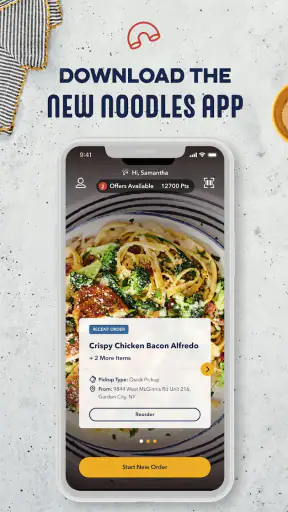
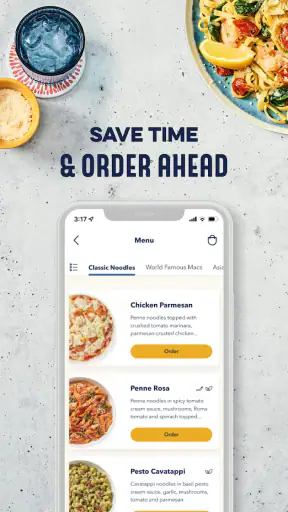
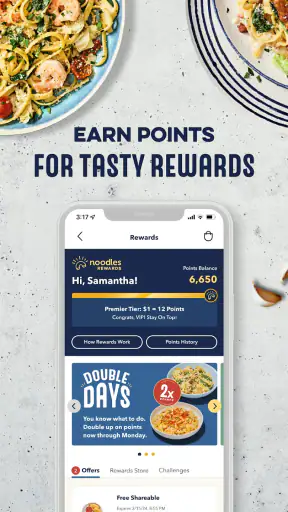
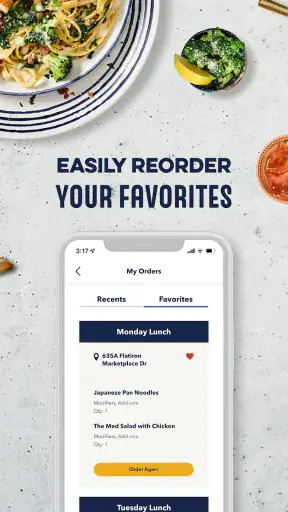
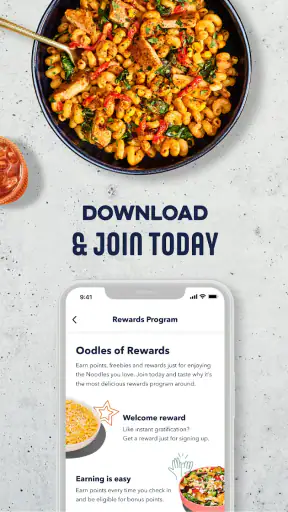
I tend to judge restaurant apps by what happens when I am hungry, distracted, and trying to coordinate a meal with someone else. On that test, Noodles & Company is more useful than a simple digital menu because it brings ordering and rewards into the same place. The app is free, belongs to the Food & Drink category, and is developed by Noodles & Company. Its central idea is straightforward: make repeat orders easier while letting customers build points through a rewards program.
That sounds simple, but simplicity matters when one person is choosing dinner and another is collecting requests from the rest of the household. I found the app most convincing when used as a practical ordering tool rather than as something to browse for entertainment. You can open it with a specific meal in mind, make choices, and use the rewards side as an ongoing reason to return. The real value is in reducing small decisions during repeat visits, not in replacing every food-ordering service you already use.
How it works when several people share the meal decision
A realistic household scenario is a weekday evening when one adult is leaving work, another person is at home, and everyone wants a slightly different noodle dish. Instead of passing a phone around while trying to remember modifications, one person can handle the order and use the app as the central place for the restaurant visit. That makes it easier to keep the meal together, especially when the group already knows which Noodles & Company dishes it likes.
I would not treat the app as a full family-management system. It is a restaurant app with a points-based rewards program, not a shared household planner. The person placing the order still needs to confirm the restaurant details, selections, and timing personally. That boundary is important: the app can support coordination, but it does not remove the need for someone to take responsibility for the final order.
For a couple or household that visits the chain regularly, the rewards element gives the app a purpose beyond one transaction. The store summary presents Noodles Rewards as a points-based program for easy ordering, and that is a fair description of the experience I would expect from its design. It is especially suitable for people who prefer keeping restaurant activity in one account rather than switching between a restaurant app and a separate delivery platform.
There is also a useful trade-off here. A shared phone can make ordering convenient, but it can blur who is actually signed in and who is responsible for the purchase. If several people use one device, I would decide in advance whose account is being used and who will check the final details. That small habit prevents a rewards balance or order history from becoming confusing later.
One account is not the same as a shared household profile
When I review an app for shared use, I look for the difference between collaboration and account sharing. Noodles & Company works well when one person coordinates a meal on behalf of others. It is less ideal if every member of a household expects a separate identity, separate preferences, or a common family dashboard. I would not assume that one login is designed to represent several people equally.
The practical workaround is simple: use one designated account for the person who most often places orders, then let other household members contribute their choices before submission. This keeps the rewards activity in one place, but it also means the household should agree on who owns that account and who can access it. That is a social arrangement rather than a feature I would attribute to the app.
This matters for shared devices. If a tablet or phone is used by parents and children, I would avoid leaving the ordering screen open where another person could accidentally change the meal. A quick review before placing the order is worthwhile, particularly when several custom choices have been made. The app can make the process faster, but speed is not a substitute for checking what is actually being purchased.
For a solo user, this is much less complicated. You can keep the account and rewards activity personal, use the app when you want Noodles & Company, and avoid the coordination questions entirely. The app feels most natural for that individual-repeat-customer pattern, while shared households need a little more discipline around access and responsibility.
Setting up the app without overcomplicating the household
My recommended setup is to begin with the person who normally decides where the meal comes from. That person can establish the account relationship, become familiar with the ordering flow, and explain to everyone else how requests will be collected. I would not create multiple accounts simply because several people eat from the same order; that can scatter the rewards activity and make the process harder to follow.
Before using it for a time-sensitive meal, I would open the app when nobody is rushing. Explore the restaurant selection and ordering path, then note where the rewards information appears. This is one of those apps that is easier to use when the first session is not happening five minutes before dinner. A calm first look helps you understand the flow and avoids turning a hungry group into a test audience.
The current version is 11.2.0, and the app supports devices running iOS or Android at version 9 or later. That makes compatibility a practical consideration for older household phones and shared tablets. If one device is kept around mainly for ordering, checking its operating-system support before relying on it is sensible, particularly when the device is no longer updated regularly.
Because the app is free, the decision to try it does not require a purchase commitment for the app itself. The important distinction is that free access to the application does not mean the meal is free. I would still treat every order as a normal restaurant purchase and review the final details before confirming it. That sounds obvious, but rewards-focused interfaces can make people concentrate on points and overlook the actual order.
Another setup boundary is notification and account access. I would choose one device as the ordinary ordering device instead of signing in everywhere without a reason. On a shared phone, that reduces accidental changes. On a personal phone, it makes the rewards experience more consistent. If the household changes who handles ordering, update that arrangement deliberately rather than allowing several people to use the account informally.
Coordinating choices when everyone wants something different
The strongest household use case is not a large formal family account; it is a short, organized exchange before one person places the order. I would collect each person’s main dish, important customization, and any drink or side request in a message or note, then enter the complete order in one pass. This avoids repeatedly reopening the app while people change their minds.
That workflow also reveals a limitation: the app is not a substitute for communication. If someone forgets to mention a change, the ordering person may not notice it while moving through the menu. I prefer a final read-back of the basket, especially when the household includes people with strong preferences or dietary concerns. The app handles the restaurant transaction; the household still has to manage the conversation.
For repeat customers, rewards can make this routine feel more worthwhile. If the same person usually coordinates dinner, concentrating eligible activity in that account may be more convenient than splitting it among several casual users. The trade-off is that the rewards relationship follows the account holder, so the household should be comfortable with that arrangement before making it the default.
I also would not confuse restaurant ordering with delivery aggregation. A third-party delivery app may be better when the household wants to compare several restaurants in one screen or combine food from different places. Noodles & Company’s own app is more focused: it makes sense when the destination is already chosen and the group wants a direct route into that restaurant’s ordering and rewards experience.
That focused approach can be an advantage during a busy evening. There are fewer competing restaurants to browse, and the decision is already mostly made. On the other hand, anyone who enjoys comparing menus, delivery fees, or nearby alternatives may prefer a broader service. The better choice depends on whether the household values loyalty to one restaurant or flexibility across many.
Age, trust, and who should control the account
The app carries an Everyone content rating, which fits its role as a food-ordering application rather than an entertainment product aimed at mature audiences. Still, an age rating does not answer the household question of who should be allowed to place an order. I would let a trusted adult or responsible account holder manage payment-related decisions and final confirmation, while younger household members can help choose dishes.
That arrangement gives children a voice without handing them the entire transaction. They can say what they want, compare options on the screen with an adult, and learn how an order is assembled. The adult remains responsible for checking the basket and submitting it. I see that as a sensible use of a shared device because it separates participation from purchasing authority.
Trust also matters between adults. If a partner or roommate uses the same account, agree on whether the account is personal or communal. A rewards balance can encourage repeat use, but it can also create disagreement if one person assumes the points belong to the household and another sees them as personal. The app cannot resolve that social question, so the household should settle it before sharing access.
I would be cautious about leaving the app signed in on a device that guests or children use freely. Even without assuming anything about specific security controls, basic account hygiene is worthwhile: keep the ordering device in a sensible place, review the basket, and avoid treating an open session as a public menu. Those habits are more useful than pretending the app can enforce household boundaries on its own.
For an older relative who is comfortable with smartphones, the focused purpose may be approachable because the app is tied to one familiar restaurant. However, if someone prefers calling the restaurant, ordering in person, or using a service that covers many restaurants, the app may add an unnecessary step. I would recommend it based on comfort and repeat use, not simply because it is available.
What the numbers suggest about everyday confidence
The app has a 4.7 average from around eighteen thousand ratings, with roughly six thousand six hundred written reviews. It has also passed one million installs. Those figures suggest that it has reached a substantial audience and that many users are comfortable enough with the experience to rate it positively. I still would not treat popularity as proof that it fits every household’s habits.
Its history also matters in a practical way. The app was released on June 12, 2013, so it is not a brand-new experiment. That longer presence makes it easier for me to view the app as an established part of Noodles & Company’s digital ordering approach rather than a temporary novelty. At the same time, an older app can feel less compelling to people who expect every restaurant service to behave like a highly polished delivery marketplace.
The developer is Noodles & Company, which gives the app a direct connection to the restaurant it represents. I prefer that direct relationship when I already know where I want to eat, because it keeps the rewards purpose close to the restaurant visit. The downside is the same thing: the experience is narrow by design and has little reason to exist for someone who rarely chooses this chain.
Where it beats ordinary alternatives, and where it does not
Compared with ordering only at the counter, the app is better for planning ahead and keeping repeat activity connected to rewards. It can be useful when one person is coordinating food for several people and wants to avoid rebuilding the order verbally at the restaurant. The counter remains better for customers who need immediate human help or who do not want to manage an account.
Compared with calling, the app gives the ordering person a visual record of the selections before submission. That is helpful for a group order, since everyone can review the chosen items in one place. A phone call may still be preferable for unusual questions or for someone who finds app navigation tiring. I would not force the digital option on a user who is already comfortable with another method.
Compared with a broad delivery marketplace, the Noodles & Company app is more focused and potentially more rewarding for loyal customers. A marketplace wins when price comparison, restaurant choice, or delivery convenience is the priority. The restaurant app wins when the household has already settled on Noodles & Company and wants a direct ordering routine. In my view, these tools are alternatives only at the moment of choice; they serve different habits.
One non-obvious trade-off is that a rewards program can change how a household decides where to eat. If points become the deciding factor, people may choose the same restaurant when another option would better suit the group. I like the rewards feature as a bonus for meals I already want, but I would not let it override dietary needs, budget considerations, or the preferences of everyone sharing the meal.
Another useful insight is to separate “ordering convenience” from “meal discovery.” This app is strongest when the restaurant decision has already been made. If the household needs inspiration, broad comparison, or a way to coordinate several restaurants, a different tool may be more suitable. Installing it will not automatically solve the first and hardest question: what everyone wants to eat.
Who should use it and who should skip it
I would recommend the app to regular Noodles & Company customers, people who often place orders for a partner or household, and anyone who wants a direct connection between ordering and rewards. It is also a reasonable choice for a user who prefers handling restaurant tasks from a phone rather than calling or waiting at the counter.
I would be less enthusiastic for someone who visits the restaurant only rarely, dislikes account-based ordering, or mainly wants to compare several restaurants at once. That person may gain little from a restaurant-specific rewards routine. Likewise, a household that cannot agree on who controls the shared account may find the convenience outweighed by confusion.
The app is free and rated for Everyone, but those facts should not be mistaken for a guarantee of effortless family use. The best experience still depends on a clear account owner, a final order check, and a realistic understanding of what the app is for. It supports coordination; it does not replace it.
My household verdict
After looking at it as both a restaurant tool and a shared-device experience, I see Noodles & Company as a focused, practical app rather than an all-purpose food platform. Its rewards connection gives repeat customers a reason to keep using it, while the direct ordering path can make a planned meal less scattered. The strongest scenario is a household that already likes the restaurant and has one reliable person coordinating orders.
I would install it for repeat Noodles & Company visits, but I would keep account ownership and final approval clear. That single rule addresses most of the friction that can appear when several people share a phone. Younger family members can participate in choosing food, partners can contribute requests, and the account holder can check the final basket before submitting it.
For a loyal customer, the combination of ordering and points is convincing enough to justify using the restaurant’s own app instead of relying exclusively on a general delivery service. For an occasional visitor or a household that wants restaurant comparison first, it is not the right centerpiece. My final view is positive but specific: Noodles & Company works best when the restaurant is already the decision and the app is used to make that decision easier to carry out.


